 Michael Thompson
Key Takeaways
- An LG dryer showing TE1 means the control board cannot get a valid reading from the inlet thermistor, so it will not turn on the heat.
- The drum still tumbles, which is why the dryer looks fine while clothes come out cold and damp.
- Do not bypass the sensor: it is a safety component, and the dryer cannot protect itself without it.
- The causes in order of likelihood are a failed thermistor, a loose or corroded connector, and a faulty main board.
- A reset can clear a one-off glitch; if tE1 returns right away, the part has failed.
The Bottom Line
TE1 means the dryer has lost its temperature reading, not its motor. Unplug it for five minutes, clean the lint filter, and book a diagnosis if the code returns, because the dryer will not heat until the sensor circuit is fixed.
The meaning of tE1 is written on this site's LG dryer tE1 code page; this guide is about what it looks like at home. It usually arrives with a very ordinary-looking dryer: the drum tumbles, the lights are on, the cycle counts down, and the clothes come out cold and damp. Nothing sounds broken. That is the signature of tE1, because the dryer is working but the control board has stopped trusting the one sensor it needs before it will switch on the heat.
| What you notice | What it points to | What to do first |
|---|---|---|
| Drum turns, no heat, tE1 on the display | Inlet thermistor reading invalid | Unplug for five minutes, then retry |
| Cycle stops partway, clothes damp | Board halted the cycle on a bad reading | Note when it stops; clean the lint filter |
| Dryer runs too hot, too cold, or erratically | Sensor values drifting or intermittent | Stop using it; have the sensor tested |
| tE1 returns right after a reset | Failed thermistor or damaged wiring | Book a diagnosis |
| Thermistor tests fine, tE1 persists | Sensor circuit on the main board | Board diagnosis by a technician |
What Does the LG Dryer TE1 Thermistor Fault Mean?
TE1 means the control board cannot get a valid temperature reading from the inlet thermistor, the sensor that watches the temperature of the air entering the drum. The code page on this site describes it as an open circuit, a short circuit, or a reading outside the expected range. Without a valid reading, the board will not energize the heating element or the gas burner, so the dryer tumbles without heat. It is rated medium severity, but it leaves the machine non-functional until it is resolved.
The thermistor is a small part, which is why this is one of the cheaper dryer faults. The difficulty is that a failed thermistor, a loose connector, and a failed board all produce the same code, so the work is in telling them apart.
Is It Safe to Keep Using an LG Dryer That Shows TE1?
No, and there is nothing to gain by trying, since the dryer will not heat while the fault is active. The code page says plainly not to bypass the sensor, because it is a safety component: without a working temperature reading, the board cannot protect the heater and the vent from overheating. A dryer running without temperature feedback is exactly the situation the sensor exists to prevent.
If clothes need drying while you wait for a repair, use a laundromat or a clothesline rather than forcing the machine to run. Do not leave a dryer running unattended while it behaves erratically, and keep the vent and lint filter clear, since a blocked vent can itself trigger temperature faults.
What to Check Before Booking a Visit
Start with the reset, because a one-off glitch can clear it. After that the checks get more involved, and the last one belongs with a technician unless you are experienced with appliance wiring.
- Unplug the dryer for five minutes, then plug it back in and start a new cycle.
- Empty and clean the lint filter, and check the vent for an obvious blockage.
- Note exactly when tE1 appears: at startup, a few minutes in, or only on certain cycles.
- Check whether the dryer shows other codes, such as the duct blockage codes; see our D80 duct blockage guide.
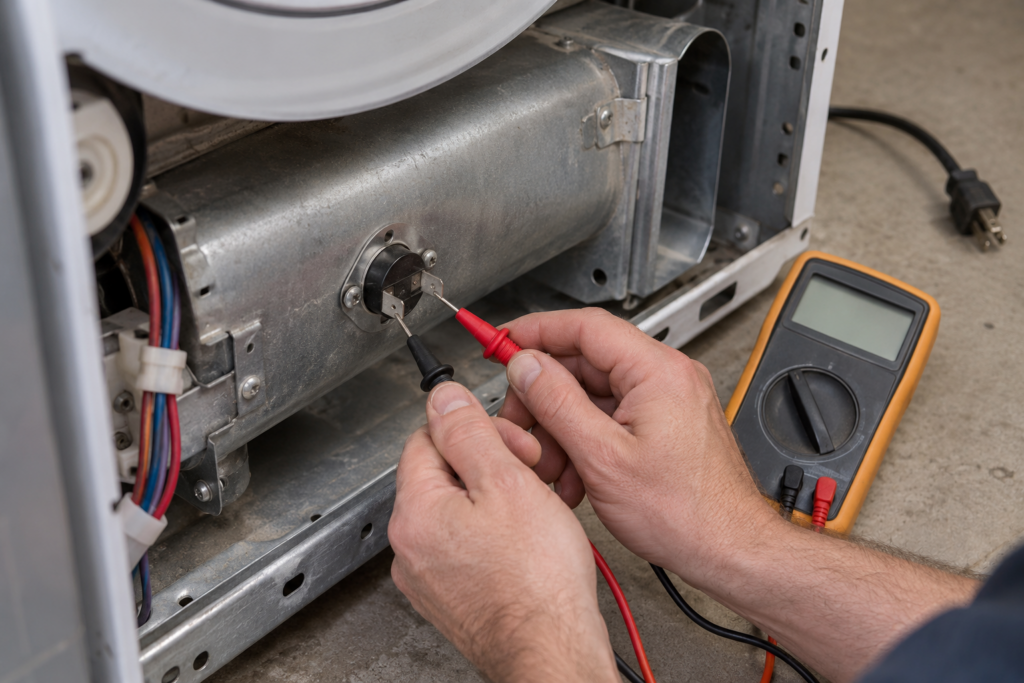
- With the dryer unplugged, a technician or experienced owner can reseat the thermistor connector and test the part with a multimeter.
The code page lists a multimeter test for the thermistor: disconnect the connector, set the meter to a 20 kilohm range, and compare the reading with the model's specification. An open reading, or one near zero, means the thermistor has failed. If you are not comfortable removing panels with the machine unplugged, leave this to a technician.
The Three Causes, in Order of Likelihood
The code page lists three causes, and the order matters because it is also the order in which a technician tests them. The first two are inexpensive repairs, and the board comes last.
- Failed inlet thermistor: burned out or drifted out of range from age and heat cycling; the usual fix is a new thermistor.
- Loose or corroded connector: vibration or moisture causes an intermittent open circuit that reads as a sensor failure.
- Faulty main control board: the sensor circuit on the board has failed even though the thermistor and wiring are fine.
A technician will test the thermistor and the harness before the board, because replacing a board on a good thermistor is the most expensive way to be wrong.
How Is TE1 Different From TE2 and HS?
TE1 concerns the inlet sensor, TE2 the secondary thermistor, and HS the humidity sensor bars, and each affects the dryer differently. The TE2 code is rated the same medium severity but warns that continuing to use the dryer risks overheating the drum, the element, or the vent. The HS code disables auto-dry cycles but leaves timed drying available, which is why it is much less serious.
- TE1: no heat at all; the board has no reading from the inlet sensor.
- TE2: a second thermistor has an out-of-range reading; stop using the dryer.
- HS: auto-dry cycles end too early or run too long; sensor bars need cleaning.
- NP: the heater circuit is not receiving power; the cause is different again.
If your dryer has shown more than one of these, tell the technician all of them. Our guide to an LG dryer not heating lists the other causes of a no-heat dryer.
What to Tell the Technician
A short description of how the fault started shortens the diagnosis, because the pattern of a thermistor fault says as much as the code. Before the visit, note when tE1 first appeared and whether it came on suddenly or built up over weeks. Mention any recent work on the dryer, such as a vent cleaning, a move, or a repair, since a connector disturbed during that work is a common cause. If the dryer also ran hot, smelled of burning, or tripped the breaker, say so, because those are separate faults that need attention before the sensor does.
Have the model and serial number ready, taken from the label inside the door frame, and tell the technician whether the dryer is gas or electric, since the thermistor sits near the burner on one and the heating element on the other.
Getting the Sensor Circuit Fixed
Our LG dryer repair service tests the thermistor, the connector, and the board in turn and gives you a written estimate before any work begins, with the final price confirmed after on-site diagnosis. For a feel for how a sensor repair compares with other dryer jobs, our dryer thermal fuse replacement cost guide sits at the same end of the price range. When you are ready, schedule a visit and tell us when tE1 appeared.