 Michael Thompson
Key Takeaways
- F9 reports a door lock failure and F10 a failure of the self-clean lock motor; baking and broiling do not use the lock and are unaffected.
- Do not run self-clean again until the lock is repaired, and do not force a door that is locked after a cycle.
- The usual repair is replacing the latch assembly: a burned-out motor, a broken latch arm or a failed micro-switch.
- Cancel the cycle, let the oven cool and look for debris at the latch hook with the power off at the breaker.
- Replace the oven only if the lock is one of several serious faults on an old unit.
The Bottom Line
Repair the lock by replacing the latch assembly, skip self-clean until it is done and never force a locked door. The price is confirmed after diagnosis, with a written estimate before work begins.
An oven door that stays locked after a self-clean cycle, or that will not lock when one is started, is usually a small part with a big effect. The lock exists so that the door cannot be opened while the oven is at cleaning temperatures, and when it fails the oven either refuses to clean or traps you out until it decides the lock is safe. The question people ask is whether to repair it or replace the oven. This guide covers LG oven door lock repair or replacement: what the F9 and F10 pages say, what you can safely do, and why the answer is almost always to repair the lock.
| What you find | Repair or replace? | Why |
|---|---|---|
| Self-clean aborts with F10, normal baking works | Repair the lock, skip self-clean meanwhile | Baking does not use the lock |
| Door will not lock, latch motor hums or clicks | Replace the latch assembly | The motor or the latch arm has failed |
| F9 after a cleaning cycle, door stuck shut | Wait for it to cool, then diagnose | Do not force the door |
| Lock fine, code returns | Look at the switch or the board | The micro-switch can fail while the latch moves |
| Old oven, several other faults | Weigh the whole oven | The lock is not the deciding cost |
What Do the LG Oven F9 and F10 Codes Mean?
F9 reports a door lock failure and F10 reports a failure of the self-clean door lock motor, which is the motor that drives the latch. They are close relatives. The oven F9 page and the oven F10 page cover ovens, and the range F9 and range F10 pages cover ranges, which share the same lock.
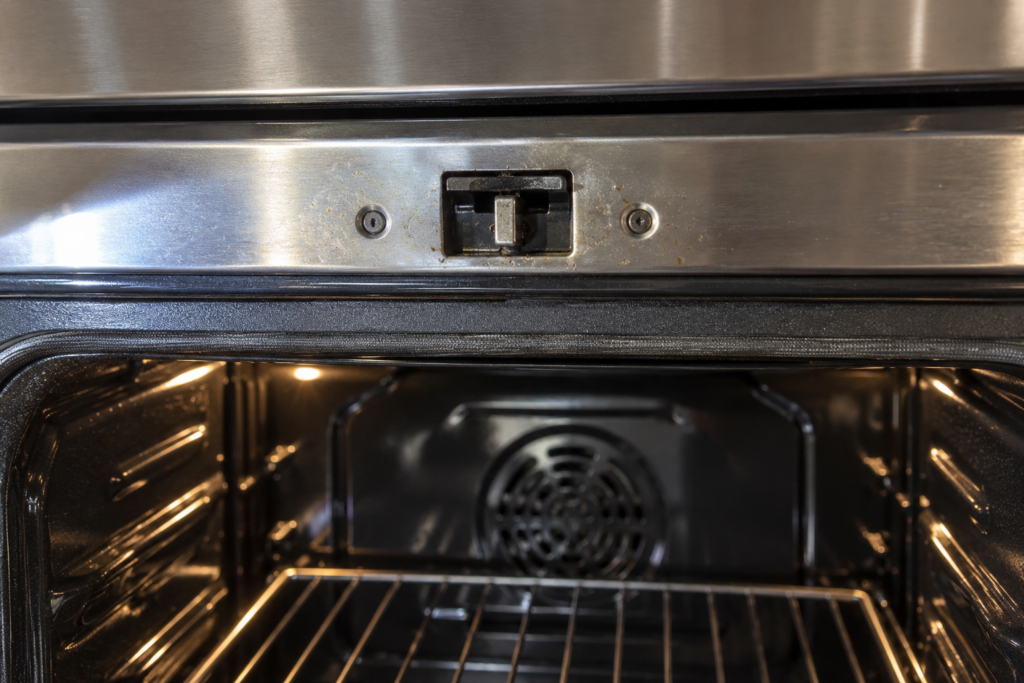
The F10 page lists three causes: a burned-out or seized lock motor, a broken latch arm or hook and a faulty micro-switch that tells the control the latch is home. Heat is the underlying wear, since the lock sits at the top of the door opening where every cleaning cycle heats it.
Is It Safe to Keep Using the Oven?
For normal cooking, yes, with a limit. The F10 page says baking and broiling do not use the door lock and are unaffected, but the self-clean cycle must not be used until the lock is repaired. Starting a cleaning cycle with a door that cannot lock risks very high temperature behind an unlocked door, which is a burn and fire hazard, and a lock that hums or clicks without finishing its travel can burn out the motor.
- Cancel the cycle. Press Cancel or Off and let the oven cool before opening the door.
- Do not retry self-clean. The code will return until the lock is replaced.
- Do not force a door that is locked. Wait for the oven to cool; the lock releases when it is safe.
- Power off at the breaker if the latch motor keeps humming. It can burn out.
Should You Repair or Replace an LG Oven Door Lock?
Repair, which in practice means replacing the lock assembly. The lock is a part of the oven, and replacing it restores the self-clean function and the safety interlock without touching anything else. Replacing the oven because of a lock fault would be like replacing a car for a door handle. The exception is an oven that has other serious problems, in which case the lock is one item among several and the decision is about the whole oven, which our guide to repairing or replacing an LG oven covers.
- Latch motor or arm failed. Replace the latch assembly.
- Micro-switch failed. A technician confirms it; the latch may be fine.
- Control involvement. If the lock tests well and the code returns, the board is next, and that changes the cost.
Why the Lock Wears Out
The lock is a small motor and a plastic and metal latch, working in the hottest part of the oven door frame, and it is asked to do its hardest work during the hottest cycle. Each self-clean cycle heats it, and the F10 page names cumulative heat damage from multiple cycles as a cause of a burned-out or seized motor. A latch arm that has been cycled through heat for years can crack, and grease or debris around the hook can stop the latch from seating fully.
None of that is a defect you could have prevented, but a few habits slow it down and make the next failure less likely.
- Wipe up heavy spills before you start a cycle. Less to burn off means a shorter, cooler cycle.
- Remove racks and loose items. A fallen rack guide near the latch is a known cause of a latch that will not seat.
- Do not open or force the door while the lock is engaged. It stresses the latch arm.
- Use self-clean when you need it, not by habit. A wipe with a damp cloth is often enough.
When the lock does fail, treat the first sign seriously: a latch that clicks or hums without finishing, a cycle that aborts with a code, or a door that feels loose where it used to feel firm. Replacing a failing latch early is cheaper than replacing it after the motor has burned out.
What Can You Check Before Booking a Visit?
A few safe steps, all from the F10 page. Cancel the cycle and let the oven cool, wait ten minutes before opening the door, then look at the latch hook along the top edge of the door frame with the power off at the breaker. A grease build-up, a fallen rack guide or broken plastic can stop the latch seating, and clearing it is within an owner's reach. Then restore power after five minutes and try once more.
If F10 returns at once, the page says the lock motor or switch has failed and must be replaced. That is a technician's job, because the lock sits behind the oven's frame and the wiring is live.
What a Good Repair Quote Includes
The latch assembly, the labor, a test of the lock through a full lock and unlock sequence and a note on the condition of the door gasket and the rest of the latch area. A diagnostic visit for an LG appliance starts from $89, with the final price confirmed after diagnosis and a written estimate before any work begins.
- The part by name. Latch assembly, motor or switch.
- A test of the lock. Locks and releases properly.
- A word on the control. Whether the board was ruled out.
Bring the model number and the exact code to the visit, since the lock assembly differs between lines. For the wider picture on the oven, see our guide to an LG oven not heating evenly. To book, schedule a visit or read about LG oven repair.